| English Title |
The Lovers |
|
|
| Director |
Louis Malle |
| Year / Length |
1958 || 90 mins |
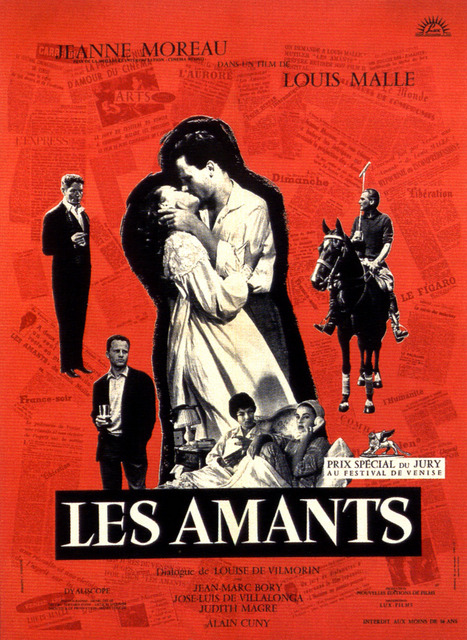
Jeanne Tournier (Jeanne Moreau) is the wife of a provincial newspaper proprietor who alleviates her boredom by spending time in Paris with her wealthy socialite friend Maggy (Judith Magre), and lover Raoul (Jose Luis de Villalonga). Returning from one such trip, her car breaks down and she is offered a lift home by a young architect Bernard (Jean-Marc Bory). That night, as they walk together through the grounds of the mansion, Jeanne finds herself falling in love with the stranger and realizes the time has come to make a decision about her future.
see also articles on:
Top 10 Films by Louis Malle || Louis Malle Profile|| French New Wave History || French New Wave Film Guide |
|
With its depiction of a married woman leaving her family for a younger man and its, for the time, frank sexuality, Les Amants created quite a scandal when it was released. It was actually banned in several American states and the Supreme Court had to rule in the film’s favour on an obscenity charge. In spite of the controversy, and partly because of it, the film was a great success and helped to established both Louis Malle’s and Jeanne Moreau’s international reputation.
Unlike his debut, the noir-ish Lift to the Scaffold, Malle’s second film, with it’s long elegant takes, bourgeois milieu, and Brahms soundtrack, was stylistically more in the tradition of classic French cinema. Indeed, it was a far cry from the innovative and rule-breaking work of his new wave contemporaries. For this reason, the film, like Malle’s subsequent work, is often considered as being somewhat tangential to the new wave movement.
Nevertheless, the film still has a strange fascination. In one memorable scene, as Moreau, her husband, and their guests sit around the dinner table; the tension simmering under the surface threatens to boil over. In an abrupt shift of tone worthy of Bunuel, a bat suddenly flies in the window causing chaos and dispelling the unease, as they attempt to shoo it out. Later, as the two lovers walk beside the river in the moonlight, the dreamy atmosphere becomes reminiscent of Cocteau. “Love can be born in one glance,” Moreau murmurs in voiceover, “and in that moment all shame and restraint dies away.”
|

 .
. .
.

 .
. .
.