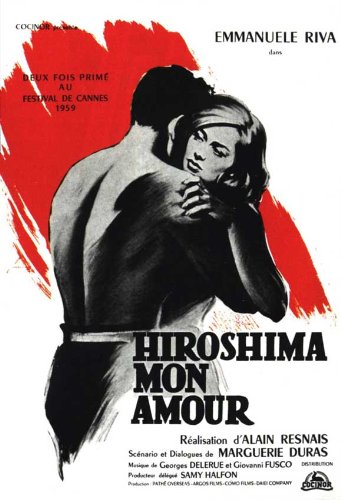
A French actress (Emmanuelle Riva) making an anti-war film in the once devastated, but now rebuilt city of Hiroshima, begins a brief but intense affair with a Japanese architect (Eiji Okado). Confronted by images of the war, and encouraged by her lover to reveal the secrets of her past, she recounts the story of her first tragic love with a German soldier during the Nazi occupation of France.
Alain Resnais’ celebrated first feature is often cited as one of the most influential films ever made. Its fractured structure, mixing past and present in a way previously only attempted in literature, it’s mature and complex treatment of character, its poetic dialogue and subjective use of sound, its deliberate blurring of the line between fantasy and reality, expanded the frontiers of cinema and inspired many filmmakers both at the time and in the years since. Its significance was immediately recognised by Cahiers du Cinéma who described it as the first truly “modern film.” Indeed, the critical acclamation was universal; review after review praised the film’s sophistication, with some comparing it favourably to Citizen Kane. Perhaps most surprisingly it was a major international success with audiences, playing for six months in Paris, London and New York, and becoming synonymous in the public mind with the groundbreaking new wave of cinema coming out of France.
Originally Resnais had been commissioned to make a documentary about the atomic bomb in the style of Night and Fog, his acclaimed film about the holocaust. However, after watching a number of films on the subject, the director became increasingly frustrated by the difficulty of producing a factual film on such a disquieting topic. Instead he decided to make a fictional film that would reflect the fact that “planes with atomic bombs were circling the earth all the time but everyone seemed oblivious.” It would be a classic love story in which the atomic bomb would be more in the background. The novelist Marguerite Duras was engaged to write the screenplay and came up with the simple story of a brief affair between a Japanese man and a French woman set in the city of Hiroshima. Around this the two collaborators weaved a Proustian study of time and memory and the devastation wrought by war.
In the powerful 10 minute prologue that opens the film, a montage of photographs, newsreel, reconstructions, and contemporary scenes of the city give us a glimpse of the documentary Resnais might have made had he stuck to his original commission. This acts in counterpoint to intimate scenes of the two lovers entwined, while off-screen the woman lists all the things she has seen in Hiroshima and the man contradicts her by saying she has “seen nothing.” This interplay of opposites runs throughout the film: war and peace, sex and death, past and present, reality and memory, France and Japan, personal versus public tragedy. This last opposition reflects the dichotomy of a traumatic world event like the bombing of Hiroshima. For those not personally affected it is impossible to comprehend the suffering that occurred; instead we are more inclined to remember an insult or injury that concerned us personally. Resnais and Duras recognised this paradox and wanted the viewer to recognise it themselves, so they focused, not on the tragedy of the bombing, but on the small and intimate foreground love story and the French woman’s recollections of her own tragic experiences in occupied France.
One of the central themes of the film – the relationship between time and memory – is one that Resnais would explore in many of his subsequent films. In the opening scene the bodies of the two entwined lovers momentarily covered in glowing ashes, recalls the atomic fall out of Hiroshima. This simultaneous conjunction of past and present is a recurring motif throughout the film suggesting time as an entirely illusory phenomenon. Indeed memory is shown to obliterate any notion of temporal separation so that the woman’s two sets of experiences appear to be happening concurrently. In one scene the position of the sleeping Japanese man’s hand evokes her German lover’s hand as he lay dead in on the ground. Then as the woman becomes more and more engrossed in her past experiences she no longer seems even able to distinguish her present lover from the past one, addressing the Japanese man as if he were the German soldier from her past. Resnais goes even further, collapsing not just time but also space, as shots of Nevers are intercut with modern-day Hiroshima, implying the two separate realities are in fact one.
That Resnais is able to so effectively convey these subjective ‘flash-ins’ of memory is down to skillful and evocative use of editing. Indeed, the techniques he perfected in a decade of documentary production – mesmerizing tracking shots that envelope the viewer in the environment, carefully composed close ups of faces and objects, decisive, revelatory editing, poetic voice over – are used to brilliant effect in his astonishingly assured first feature. Working with dual cinematographers – Michio Takahashi in Japan, Sacha Vierny in France – Resnais conjures up unforgettable visual imagery in Hiroshima mon amour. From the first scenes of two intertwined bodies sequentially filmed with what Duras described as “ashes, dew, atomic fallout – and the sweat of completed love”, to the night-time tracking shots of Emmanuelle wandering the ghostly, deserted streets of the Japanese city, the film leaves an indelible impression. Rarely has human anguish been captured so powerfully. The opening montage shows Resnais the documentarian at his most effective as he takes us inexorably from museum hallway to hospital corridor to newsreel footage of the immediate aftermath of the atomic explosion – the sedate, gliding camera leading us back in time and history both literally and figuratively. Later he proves himself equally adept at portraying intense human drama as the woman relates the story of her affair and its tragic consequences. The scenes of the young woman’s humiliation at the hands of vengeful villagers and her enforced imprisonment in the family cellar are amongst the most harrowing ever put on screen.
The unusual relationship between sound and picture in Hiroshima mon amour is another of the film’s distinctive features. Rarely do word and image correspond; instead we are left uncertain whether we are hearing real conversation, imaginary dialogue, or commentary spoken by the characters. Duras’s dialogue is both lyrical and oblique. Emmanuelle Riva, who was chosen to play the woman in part because of the timbre of her voice, recites many of her lines as if hypnotised or dreaming. It is as if we were listening to a radio tuned in directly to the characters’ inner thoughts and memories. The musical speech of memory spoken by Riva and Japanese actor Eiji Okada sets a dominant tone against which the discordant breaks in time and visual rhythm form a dynamic counterpoint. The two elements are effectively held together by Georges Delerue and Giovanni Fusco’s resonant musical score.
Hiroshima mon amour received instant acclaim when it was shown at the 1959 Cannes Film Festival and along with Les Quatre cents coups (The Four Hundred Blows) helped to define and popularize the French New Wave, becoming a surprise international hit. Marguerite Duras’s screenplay was nominated for an Academy Award and the film won the New York Film Critics’ award for Best Foreign Film. Reviewers were lavish in their acclaim. Jacques Chevalier wrote in Image et son: “For the first time, cinema achieves ‘the remembrance of things past,’ creating a temporality that one can call ‘novelistic,’ mixing the past and present in a dialectical fashion that previously seemed impossible to accomplish in cinema.” At Cahiers du cinema, Jean-Luc Godard called it ‘Faulkner plus Stravinsky plus Picasso’ and the first film without any cinematic references. Jacques Rivette said it returned cinema to the ‘fragmentation of Eisenstein within a narrative labyrinth worthy of Borges’. Even Alfred Hitchcock recognised the film’s importance when he described his juxtaposition of the final scenes in North by Northwest (1959) as comparable to the montage style of Hiroshima mon amour.
Now considered a landmark in post-war cinema, a modernist masterpiece that presaged much of what was to come, Hiroshima mon amour still defies easy analysis.
Is it about a love affair? Or is it about the French woman’s buried past? Or is it about two places where tragedy occurred? The fact that the film raises more questions than answers goes someway to explain its enduring resonance. At its heart the film asks the question: Is it better to try to forget tragedy or to remember?” The French woman would like to forget her past but her subconscious won’t let her. On a conscious level she has managed to forget and it is only because of the similarities between the German and the Japanese man, and his probing, that she begins, in an involuntary way at first, to remember. Still she resists, jealously guarding her memories, preferring to end her relationship with the Japanese man rather than remember. By contrast the man, while insisting that Hiroshima was a personal tragedy that can only be understood by those who went through it, is willing to share his personal experiences of the event. This reflects a healthier attitude to past trauma, shared by the people of Hiroshima, who, by openly commemorating what happened to them in their museums, monuments and marches, are making sure that what happened will never be forgotten. And yet at the same time the city has been rebuilt and they have moved on; the Japanese man’s occupation as an architect is a symbolic reminder of this. By recalling her buried past, the woman, like the people of Hiroshima, has the opened the door to the possibility of healing and rebirth. The consequences of not doing so are made clear by the woman herself: “Listen to me. I know something else. It will begin all over again. Two hundred thousand dead. Eighty thousand wounded. In nine seconds. These figures are official. It will begin all over again. It will be ten thousand degrees on the earth. Ten thousand suns, they will say. The asphalt will burn. Chaos will prevail. A whole city will be raised from the earth and fall back in ashes….”

 .
. .
.

 .
. .
.